Preparing for a winter baby often feels a bit more demanding than for a summer baby. You think of cold, walks, warm clothes, hats, blankets, sleeping bags, footmuffs, and the question: will my baby be warm enough?
At the same time, there's a high risk of buying too much, especially in winter. Too many layers. Too many small sizes. Too many things that only fit for a few weeks. And sometimes, clothes that are too warm and not often needed in everyday life because your baby spends a lot of time indoors, in a carrier, or in a stroller footmuff.
A good winter baby layette therefore doesn't mean buying as much as possible. It means choosing a few well-combinable items that keep your baby warm without overheating them.
In this article, you'll find practical, natural, and undogmatic guidance for your winter baby: What clothes do you really need? Which materials make sense? What belongs in the hospital bag? What helps during the postpartum period, on the go, when sleeping, changing diapers, and practicing elimination communication?
What's different about a winter baby?
A winter baby is born in a season where warmth, protection, and good layering are particularly important. Newborns cannot regulate their temperature as reliably as adults. They therefore need clothes that keep them warm but also remain breathable.
The crucial point is: a baby should not be bundled up as thickly as possible in winter. It should be comfortably warm. Especially in heated rooms, in a carrier, or in the car, too much clothing can quickly become too warm.
For a winter baby, you primarily need:
- soft base layers directly on the skin
- warming middle layers
- a good outer layer for outdoors
- hat, socks, and protection for tiny feet
- a warm blanket or a footmuff
- clothing that can be easily opened for diaper changes or elimination communication
- not too many items in the smallest size
Detailed guidance on dressing can be found in the article Dressing your baby in winter: warm without overheating.
The most important rule: Layers instead of over-bundling
For winter babies, the onion principle (layering) is particularly useful. Several well-combined layers are more practical than a single very thick piece of clothing.
Layers help you react flexibly. When you come from outside to inside, you can open or remove a layer. When your baby is in the carrier, it gets additional body heat. When it's in the stroller, it needs more protection because it hardly moves.
A simple layering structure could look like this:
- First layer: Bodysuit made of wool, wool/Tencel, or cotton
- Second layer: Soft pants and top or one-piece suit
- Warming layer: Wool jacket, wool pants, or wool suit
- Outer layer: Boiled wool overall, footmuff, or wool blanket
- Extras: Hat, wool socks, leg warmers, or warm booties
This structure is not mandatory. It merely provides guidance. Your baby, your home, your daily routine, and the weather always play a role.
Which materials are suitable for a winter baby?
With a winter baby, a conscious look at materials is particularly worthwhile. Clothing should warm, but not feel stuffy. It should be soft, but suitable for everyday use. It should accompany baby's skin without unnecessary irritation.
Wool
Wool is one of the most valuable materials for babies in winter. It warms, can absorb moisture, and helps regulate temperature. Many wool items don't need to be washed after every short wear; they can simply be aired out.
Wool/Tencel
Wool/Tencel is particularly soft and comfortable on the skin. It's well-suited for close-to-the-body layers if you want to combine warmth with a smooth feel.
Boiled wool
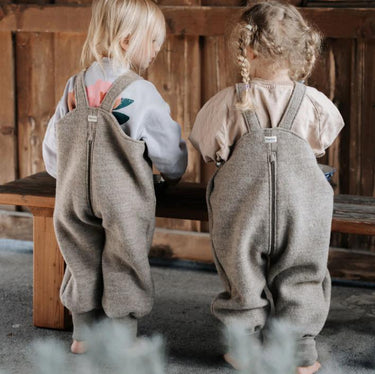
Boiled wool is very practical as an outer layer. A boiled wool overall can protect your baby well outdoors, yet remains more breathable and flexible than many heavily padded garments.
Cotton
Cotton is familiar, easy to care for, and suitable for many basics. In winter, however, it should be combined thoughtfully, as cotton can feel cool more quickly when it gets damp.
More about material selection can be found here: Natural Baby Clothing: Wool, Wool/Tencel, and Cotton Compared.
Winter Baby Clothes: The Essential Basic Equipment
For the first few weeks, you don't need a huge wardrobe. Your baby grows quickly, and you'll only realize after the birth which cuts and materials truly suit you.
A good winter baby basic outfit can look like this:
- 5 to 7 long-sleeved bodysuits
- 4 to 6 soft pants or leggings
- 2 to 4 pajamas or one-piece suits
- 2 to 3 warming tops or cardigans
- 1 boiled wool overall or warm outer layer
- 2 hats, one warmer for outdoors
- 3 to 5 pairs of warm socks or wool socks
- 1 wool blanket
- if needed, leg warmers for carrier or stroller
- practical clothing for changing or elimination communication
This list is deliberately minimal. If your baby spits up a lot or you wash less frequently, you can plan for a bit more. If you want to start very minimally, often fewer items and targeted subsequent purchases are sufficient.
If you want to plan the entire baby layette more broadly, you can find the overview here: Baby Layette: What You Really Need.
What sizes does a winter baby need?
For winter clothing, size planning is particularly important because warming clothing is often of higher quality and more expensive. It would be a shame if a boiled wool overall or warm wool trousers were too small after just a few days.
For most winter babies, size 56 is the most important starting range. You only need a small amount of size 50 if your baby is estimated to be rather small. You should consider size 62 early on.
A sensible size distribution
- Size 50: a few pieces if your baby is estimated to be rather delicate
- Size 56: focus for bodysuits, trousers, and first clothes
- Size 62: important reserve for the next few weeks
- Outerwear: preferably plan with some room to grow
Detailed size guidance can be found here: Which baby size for birth: 50, 56 or 62?.
How many bodysuits does a winter baby need?
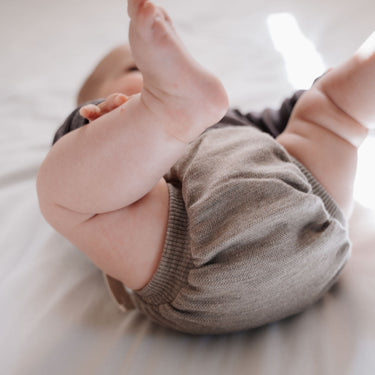
A winter baby primarily needs long-sleeved bodysuits. They form the first layer on the skin and are worn under trousers, cardigans, pyjamas, or overalls.
For the beginning, 5 to 7 long-sleeved bodysuits are usually sufficient. If you wash infrequently or your baby spits up a lot, 8 to 10 bodysuits can be more relaxing.
Practical for a winter baby:
- 5 to 7 long-sleeved bodysuits
- a few short-sleeved bodysuits if your home is very warm
- more size 56 than size 50
- some bodysuits in size 62 as a reserve
- soft, temperature-regulating materials
You can find more on this in the article How many bodysuits does a newborn need?.
Wrap-around bodysuit or slip-on bodysuit in winter?
For winter babies, wrap-around bodysuits are particularly practical in the first few weeks. They don't have to be pulled over the head and can be put on calmly. This is pleasant when your baby is still very small and you yourself, in the postpartum period, don't want unnecessarily complicated maneuvers.
Slip-on bodysuits can be a good addition later. With both variants, it's important that they are soft, fit well, and don't pinch in the diaper area.
Useful for the first few weeks:
- more wrap-around bodysuits than slip-on bodysuits
- soft fasteners
- enough length in the torso
- no scratchy labels
- material that is comfortable directly on the skin
More on this decision can be found here: Wrap-around bodysuit or slip-on bodysuit: Which is better?.
Boiled wool overall: Does a winter baby need one?
A boiled wool overall is very useful for many winter babies. It serves as a warm outer layer for walks, strollers, short trips, and cold days. Boiled wool warms well, but remains breathable and often feels less stiff than heavily padded snowsuits.
Whether you really need one depends on your daily routine. If your baby spends a lot of time in the stroller outdoors in winter or you regularly go for walks, a high-quality overall is very practical. If your baby is almost exclusively in the carrier under your jacket, you may need less thick outerwear.
When choosing an overall, pay attention to:
- enough space for layers underneath
- sleeves and legs that are not too tight
- soft cuffs
- good freedom of movement
- a size that isn't too small after just a few days
- a material that warms and remains breathable
For high-quality outerwear, it often makes sense not to choose the very smallest size, but to plan for some room to grow.
A suitable outer layer for cold days can be found here: Boiled Wool Overall.
Wool blanket, footmuff, or both?
For a winter baby, a blanket and a footmuff are different aids. A footmuff is particularly practical in the stroller because it provides even warmth and protects your baby well. A wool blanket is more flexible: it can be used in the stroller, on the sofa, during the postpartum period, while breastfeeding, or as an additional layer.
You don't automatically need multiple blankets and multiple footmuffs. Instead, ask yourself what your daily routine will look like.
A wool blanket is practical:
- during the postpartum period
- on the sofa
- while breastfeeding or feeding
- in the stroller as an additional layer
- for short trips
- as a long-lasting favorite item
A footmuff is practical:
- for regular stroller walks
- in cold wind
- if your baby is outside for longer periods
- if you want a permanent winter solution for the stroller
It's always important: your baby should not overheat. If a footmuff is very warm, your baby often needs less thick clothing underneath.
Winter baby in the carrier: What do you need?
If you want to carry your baby a lot in winter, you'll need different equipment than for a baby primarily in a stroller. In the carrier, your baby receives your body heat. In addition, a babywearing jacket or cover protects against the cold.
Very thick overalls are often impractical in the carrier because they can alter posture, create pressure, and quickly become too warm.
Helpful for babywearing in winter:
- soft base layers
- light to medium wool layer
- warm socks or leg warmers
- well-fitting hat
- babywearing jacket or cover
- no excessively bulky clothing between you and your baby
Pay particular attention to feet, head, and exposed areas. Your baby's torso is usually well warmed by your body.
More on this can be found here: Dressing your baby in the carrier: What does your baby really need?.
Winter baby in the stroller: What do you need?
In the stroller, your baby hardly moves. Therefore, it needs more external thermal protection there than in the carrier. Footmuff, wool blanket, hat, and warm feet play a larger role here.
Useful for the stroller in winter:
- warming clothes in layers
- hat
- wool socks or booties
- footmuff or warm blanket
- wind protection depending on the weather
- regular neck check
If you go into cafes, shops, or warm indoor spaces, you should open or remove layers so your baby doesn't sweat.
More on this can be found here: Dressing your baby in the stroller: What does your baby need outside?.
Winter baby in the car: Less thickness is often safer
It quickly gets warm in the car. Moreover, your baby should be able to be safely buckled into the car seat. Very thick, bulky clothing under the harness is unsuitable because the harness cannot lie close enough to the body.
Thinner layers and a blanket over the buckled baby are more practical. You can remove the blanket when it gets warm in the car.
For car rides in winter:
- no very thick overalls under the harness
- rather thinner layers
- securely buckle up baby
- place blanket over harnesses if necessary
- remove hat in warm car if applicable
If you are unsure, consult the manufacturer of your car seat or a child car seat specialist.
More on this can be found here: Dressing your baby in the car: safe and warm in the infant car seat.
Sleeping in winter: What does your baby need?
At night, your baby needs a good balance of warmth and protection from overheating. Many families use a bodysuit, pajamas, and a suitable sleeping bag in winter. Which combination makes sense depends on the room temperature and your baby.
Helpful for sleeping in winter:
- breathable sleepwear
- suitable sleeping bag
- no unnecessarily thick layers
- neck check instead of relying only on hands or feet
- reduce a layer if sweating
Loose, heavy blankets are not always suitable for baby sleep. Pay attention to a safe sleeping environment and seek advice from your midwife or pediatrician if you are unsure.
More on this can be found here: Dressing baby at night: What does a newborn need for sleeping?.
Postpartum period with a winter baby
A winter baby often means: a lot of time indoors, a lot of cuddling, warm rooms, short distances, and a particularly strong desire for security. This can be wonderful but requires preparation.
In the postpartum period, the perfect nursery isn't important. More important is that you can rest, food is available, visits are limited, and everything for your baby is within reach.
Helpful for the winter postpartum period:
- warm resting places for you and your baby
- wool blanket or light blanket within reach
- baby clothes sorted by size
- changing or elimination communication spot without drafts
- warm drinks and food prepared
- household support
- clear visitor boundaries
More on this can be found in the article Preparing for the postpartum period: What you can organize before birth.
Diaper changing in winter
When changing diapers in winter, warmth is particularly important. Babies often don't like lying naked on the changing table for long. A well-prepared changing area makes the process calmer.
Helpful for diaper changing:
- draft-free changing area
- soft changing pad
- spare clothes within reach
- warm hands
- washcloth and warm water within reach
- only undress as much as necessary
If your baby gets cold quickly, clothes with easy openings can make all the difference. You don't have to undress their whole body every time.
More on this can be found here: Setting up a changing station: What you really need.
Elimination Communication and Diaper-Free with a Winter Baby
Many parents wonder if elimination communication is even practical in winter. The answer is: yes, if the clothing fits and you don't put pressure on yourself for perfection.
In winter, it's particularly helpful if you can quickly open the diaper area without completely undressing your baby. This keeps your baby warm, and elimination communication doesn't become a lengthy changing process.
Practical for diaper-free in winter:
- elimination communication pants
- elimination communication diapers as backup
- absorbent inserts
- changing mat
- a small elimination communication potty within reach
- soft wool layers over them
Suitable items can be found here: Elimination Communication Pants, Elimination Communication Diapers, Diaper Inserts and the Portable Changing Mat.
If you'd like to learn more about elimination communication in general, you can find an introduction here: What does "diaper-free from birth" actually mean?.
If you want to know what you really need to start with elimination communication, read on here: Elimination Communication Starter Kit: What you really need.
What belongs in the hospital bag for a winter baby?
For the hospital, you don't need the entire winter outfit. Many hospitals provide baby clothes during the stay. The outfit for the journey home is particularly important.
Useful for a winter baby in the hospital bag:
- 1 to 2 long-sleeved bodysuits in size 50/56 or 56
- 1 soft pair of trousers or a one-piece suit
- 1 warming jacket
- 1 hat
- warm socks
- wool blanket or warm swaddle blanket
- suitable outer layer for the journey home
If you are driving home by car, make sure your baby can be safely buckled into the infant car seat. Very thick clothing under the harness is not advisable.
More about the hospital bag can be found here: Packing your hospital bag: Naturally, practically, and without too much ballast.
What you don't immediately need for a winter baby
With winter babies, more is often bought than necessary. Many things seem useful but are rarely used or only fit for a short time.
You can often plan these items conservatively:
- several thick overalls in small sizes
- too many hats
- very many items in size 50
- several thick blankets
- shoes with firm soles for a newborn
- complicated outfits that hinder diaper changes
- winter clothes that only look nice but are not practical for everyday use
A newborn doesn't need a complete winter wardrobe like a walking toddler. It needs warmth, soft clothes, good layers, and protection in situations where you're really outside.
Sustainable Winter Baby Layette
Winter clothes can quickly become expensive. That's why it's particularly worthwhile to plan sustainably and consciously.
Sustainable doesn't mean buying everything new or everything perfectly ecological. Sustainable can also mean: buying less, choosing higher quality, supplementing with used items, taking good care of them, and passing them on later.
For a sustainable winter layette:
- don't buy too much in size 50
- opt for grow-with-me styles
- choose natural materials
- combine a few high-quality pieces with practical basics
- ask for gifts in size 62 or 68
- care for wool well and air it regularly
- pass on well-preserved clothes
You can find detailed guidance in the article Sustainable Layette: Buy Less, Choose Better.
How to sensibly prepare baby clothes before birth can be found here: Washing Baby Clothes Before Birth: What's Really Sensible.
Winter Baby Layette: Compact Checklist
Clothing
- 5 to 7 long-sleeved bodysuits
- 4 to 6 soft pants
- 2 to 4 sleepsuits or one-pieces
- 2 to 3 warming tops or cardigans
- 1 wool fleece overall or warm outer layer
- 2 beanies
- 3 to 5 pairs of warm socks or wool socks
Sleeping and At Home
- suitable sleeping bag
- wool blanket for awake, supervised situations
- warm, but not overheated rooms
- draft-free changing area
On the Go
- footmuff or warm blanket for the stroller
- hat and warm feet
- carrier cover or carrier jacket if you want to carry
- blanket for the car over the straps, if needed
Diapering and Elimination Communication
- soft changing pad
- washcloths
- change of clothes
- elimination communication diaper or backup
- liners
- elimination communication pants if you want to try diaper-free
Frequent Questions About Winter Baby Layette
What does a winter baby really need?
A winter baby needs soft base layers, warming clothes, a good outer layer for outside, a hat, warm socks, a blanket or footmuff, and practical clothes for diapering. Good layers are important, rather than a lot of clothes.
How many bodysuits does a winter baby need?
For starters, 5 to 7 long-sleeved bodysuits are usually enough. If your baby spits up a lot or you wash less often, 8 to 10 bodysuits may be useful.
Does a winter baby need a wool fleece overall?
A wool fleece overall is very practical if you are regularly outdoors or use the stroller. If your baby is almost exclusively carried under your jacket, a lighter outer solution may suffice.
What size should I buy for a winter baby?
Size 56 is the most important starting size for many newborns. Size 50 only in small quantities if your baby is estimated to be rather small. You should plan for size 62 early, especially for high-quality winter clothes.
How do I dress a winter baby in the stroller?
In the stroller, your baby needs good layers, a hat, warm feet, and, depending on the temperature, a footmuff or wool blanket. Regularly check the back of their neck to ensure your baby is neither too cold nor overheated.
How do I dress a winter baby in a carrier?
In the carrier, your baby receives your body heat. Therefore, a good base layer, a light to medium wool layer, warm feet, a hat, and a carrier jacket or cover are often sufficient.
Can you do elimination communication with a winter baby?
Yes. Elimination communication is also possible in winter. Particularly helpful are elimination communication pants, elimination communication diapers, inserts, and clothing that can be opened quickly without your baby getting cold.
A Calm Thought to Conclude
A winter baby needs warmth. But it doesn't need an overflowing layette.
If you choose a few good layers, use natural materials, and plan clothing to work in everyday life, you are very well prepared. Your baby doesn't have to be perfectly dressed at all times. You can check, adjust, and learn.
A good winter baby layette protects without being cumbersome. It warms without overheating. It supports closeness, the postpartum period, walks, diapering, and perhaps the first elimination communication moments.
This is how the cold season becomes a secure beginning.
If you want to accompany your baby with natural materials, practical cuts, and an undogmatic view of diapering, elimination communication, and closeness, you will find thoughtful companions for precisely this first time at Mata Origin.
Discover suitable products for cold days and your baby's everyday life: Wool Fleece Overall, Elimination Communication Pants, Elimination Communication Diapers, Diaper Liners and the On-the-Go Changing Pad.
Note: This article does not replace medical advice. It is intended to provide guidance. In case of premature birth, illness, fever, unusual temperature, uncertainty, or specific health questions, please consult your midwife, pediatrician, or doctor.