
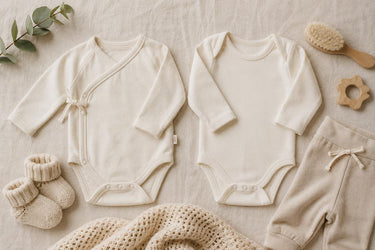
When you're preparing baby clothes for the first few weeks, this question will sooner or later arise: wrap bodysuit or slip-on bodysuit — which is better for a newborn?
Both options have their advantages. A wrap bodysuit can be fully opened and doesn't need to be pulled over the head. A slip-on bodysuit is simple, familiar, and often quick to put on later. Especially with a first baby, the decision can be unsettling because newborns seem so small, delicate, and sensitive at the beginning.
The short answer is: For the first few weeks, wrap bodysuits are particularly practical for many families. They can be put on calmly, without having to pull the bodysuit over the baby's head. Slip-on bodysuits can also be useful, especially when your baby is a bit bigger or you've become more confident with dressing them.
In this article, we'll take a close look at both options: What is a wrap bodysuit? What is a slip-on bodysuit? What are the pros and cons? What materials are comfortable? And what's practical if you're changing diapers, using cloth diapers, or want to try elimination communication or infant potty training?
If you're generally planning what clothes your baby needs at the beginning, you'll find a good overview here: What clothes does a newborn really need?.
What is a wrap bodysuit?
A wrap bodysuit is a baby bodysuit that is not pulled over the head. Instead, it opens at the front or side, is wrapped around the body, and fastened with snaps, ties, or other closures.
This is particularly comfortable in the first few weeks, as many newborns don't like clothes being pulled over their heads. Parents often feel more secure with a wrap bodysuit too, as they have to lift or turn the baby less.
Typical features of a wrap bodysuit
- can be opened completely or widely
- is wrapped around the body
- does not need to be pulled over the head
- usually has snaps or ties
- is particularly popular for newborns and the first few weeks
A good wrap bodysuit should be soft, lie flat, and not have any hard closures that might bother your baby when lying down.
What is a slip-on bodysuit?
A slip-on bodysuit is the classic baby bodysuit that is pulled over the head. It usually has a stretchy neckline, American shoulders, or snaps at the neckline to make it easier for the head to pass through.
Slip-on bodysuits are very common. Many parents like to use them later because they are simple, quick, and uncomplicated. In the very first few days, however, they can feel a bit unusual if you are still unsure how to hold your baby properly when dressing them.
Typical features of a slip-on bodysuit
- is pulled over the head
- often has a stretchy neckline
- is simply constructed
- usually has fewer fasteners than a wrap bodysuit
- is often quick to put on later
A slip-on bodysuit is not inferior to a wrap bodysuit. It just requires a bit more routine when dressing, especially for very small babies.
Wrap bodysuit or slip-on bodysuit: The brief recommendation
For the first days and weeks after birth, wrap bodysuits are often the more comfortable choice for many families. They can be put on more calmly, are particularly newborn-friendly, and make changing clothes easier in the postpartum period.
Slip-on bodysuits can be a great complement when your baby seems a bit more stable or you feel more confident with dressing them.
A sensible mix for the beginning
- 3 to 5 wrap bodysuits for the first few weeks
- 2 to 3 slip-on bodysuits as a supplement
- more long-sleeved bodysuits for winter babies
- more short-sleeved bodysuits for summer babies
- not too many bodysuits in size 50
If you want to start minimalist, 5 to 7 bodysuits in total are enough. You can find a more detailed explanation of how many bodysuits you need here: How many bodysuits does a newborn need?.
Why wrap bodysuits are often more practical for newborns
Newborns often still seem very delicate in the first few days. The head needs good support, movements are unfamiliar, and many parents want to avoid pulling, turning, or stretching too much when dressing them.
A wrap bodysuit can relieve this stress. You lay it open on the changing mat, place your baby on it, wrap the sides around the body, and close the bodysuit. This is calm, clear, and easy to control.
Advantages of wrap bodysuits
- no pulling over the head
- comfortable for very small babies
- practical immediately after birth
- helpful for uncertain first attempts at dressing
- well-suited for the postpartum period
- easier for babies who dislike getting dressed
Especially at night or when your baby is tired, an easy-to-open bodysuit can make everyday life noticeably calmer.
When slip-on bodysuits are useful
Slip-on bodysuits also have clear advantages. They are often simple, have fewer closures, and sometimes fit particularly smoothly under clothing. If you're more experienced with dressing, they can be very quick.
Many parents particularly like using slip-on bodysuits after a few weeks or months. Some even use them from the beginning if the baby tolerates having clothes pulled over their head well.
Advantages of slip-on bodysuits
- simple and uncomplicated
- often fewer closures
- quick to put on later
- good to wear under other layers
- wide selection of materials and cuts
If you buy slip-on bodysuits for a newborn, pay special attention to a soft, stretchy neckline. The bodysuit should not have to be pulled tightly over the head.
What's more practical during the postpartum period?
Everything is new in the postpartum period. Your baby is frequently changed, dressed, breastfed or fed, and held a lot. You yourself are recovering. Therefore, clothes that cause little stress are ideal.
For this time, wrap bodysuits are usually particularly comfortable. They can be prepared on the changing mat and fastened with a few calm movements. If your baby has fallen asleep after feeding or becomes restless quickly during changing, this can be very helpful.
This doesn't mean that slip-on bodysuits are wrong during the postpartum period. But if you're unsure before birth, it makes sense to plan for more wrap bodysuits than slip-on bodysuits for the first few weeks.
If you want to prepare for your postpartum period in general, you'll find a detailed guide here: Preparing for the postpartum period: What you can organize before birth.
What's better for the hospital bag?
For the hospital bag, wrap bodysuits are particularly practical. Right after birth, you probably want the simplest possible clothes for your baby. A bodysuit that doesn't need to be pulled over the head is ideal for this.
Depending on whether your hospital provides baby clothes, you might only need one or two of your own bodysuits for the journey home. It's best to ask beforehand.
Useful for the hospital bag
- 1 to 2 wrap bodysuits in size 50/56 or 56
- a soft pair of trousers or an all-in-one
- socks
- hat
- a warming layer depending on the season
You can find more about the entire hospital bag here: Packing your hospital bag: Natural, practical, and without too much ballast.
Which type of bodysuit is better in winter?
In winter, it's less about the type of bodysuit and more about the material, sleeve length, and layering. Nevertheless, wrap bodysuits can be comfortable in winter because your baby doesn't have to be undressed for as long when putting them on.
For winter babies, long-sleeved bodysuits are usually sensible. Natural materials that warm and regulate temperature are particularly comfortable. Wool, wool/Tencel, or high-quality cotton can be suitable depending on the situation.
Practical for winter babies
- more long-sleeved bodysuits than short-sleeved bodysuits
- wrap bodysuits for the first few weeks
- soft materials directly on the skin
- enough space for diaper, cloth diaper, or insert
- layers instead of one very thick garment
You can find a detailed guide here: Dressing your baby in winter: warm without overheating.
If you're expecting a winter baby, you'll also find a complete overview here: Winter baby essentials: What you really need.
Which type of bodysuit is better in summer?
In summer, both wrap bodysuits and slip-on bodysuits can work well. The crucial factor is that the fabric is light, soft, and breathable.
In very hot weather, a short-sleeved bodysuit or a very light long-sleeved bodysuit is often sufficient. Outdoors, a light long-sleeved bodysuit can also protect against the sun if it fits loosely and your baby stays in the shade.
Practical for summer babies
- light short-sleeved bodysuits
- a few thin long-sleeved bodysuits
- loose fit
- breathable materials
- few, quickly changeable items
If you want to dress your baby correctly in warm weather, you can find more information here: Dressing your baby in summer: light and breathable.
If you're expecting a summer baby, you'll also find a suitable overview here: Summer baby essentials: What you really need.
What materials are best for bodysuits?
Since bodysuits lie directly on baby's skin, it's worth taking a conscious look at the material. It should be soft, not scratchy, not stiff, and suitable for the season.
For Mata Origin, natural, high-quality materials are central. Particularly relevant are wool, wool/Tencel, and high-quality cotton.
Wool
Fine wool can provide warmth and regulate temperature. It is particularly valuable in cooler months and often doesn't need to be washed after every short wear.
Wool/Tencel
Wool/Tencel feels soft, light, and smooth. It can be a very comfortable first layer, especially if you are looking for natural materials with a gentle feel.
Cotton
Cotton is familiar, easy to care for, and practical. It is well-suited for robust everyday basics and frequent washing.
You can find more about material choices here: Natural baby clothes: Wool, Wool/Tencel, and Cotton compared.
Wrap bodysuit or slip-on bodysuit with cloth diapers?
If you use cloth diapers, the length and fit of the bodysuit are particularly important. Cloth diapers often create a bulkier diaper package than disposable diapers. A too-tight bodysuit can then strain or compress the diaper.
Whether it's a wrap bodysuit or a slip-on bodysuit is less crucial than having enough space in the diaper area.
When using cloth diapers, pay attention to:
- sufficient torso length
- soft snaps
- not too tight a fit
- stretchy material
- enough freedom of movement around the tummy and hips
If a bodysuit pulls tightly at the bottom or puts pressure on the diaper, it's probably too small or not ideal for your diaper system.
If you're still considering whether disposable diapers, cloth diapers, or elimination communication are right for you, you can find a good guide here: Disposable diapers, cloth diapers, or elimination communication: What options are there?.
Wrap bodysuit or slip-on bodysuit for elimination communication?
If you want to try elimination communication or infant potty training, clothing becomes important in a different way. The key is how quickly and calmly the diaper area is accessible.
A bodysuit can be practical for infant potty training because it keeps the tummy warm. However, it can also get in the way if it has to be opened at the crotch every time. Therefore, many families combine bodysuits with split-crotch pants, elimination communication diapers, or other garments that facilitate access.
Helpful for elimination communication
- bodysuits that open quickly
- not too many layers on top of each other
- soft pants with easy opening
- elimination communication diapers as backup
- absorbent inserts
- clothing that retains warmth and yet remains accessible
If you want to practice elimination communication a lot, shirts or undershirts can be a sensible addition because they leave the diaper area more open. For the start, however, it's enough to consciously combine the clothing.
You can find a gentle introduction here: What does elimination communication from birth actually mean?.
If you want to know what you really need to get started with elimination communication, read on here: Elimination Communication Starter Kit: What you really need.
What is better: bodysuit or undershirt?
The bodysuit has the advantage that it doesn't ride up and keeps the tummy warm. This is particularly comfortable for newborns, as they are carried a lot and often lie down.
An undershirt or shirt leaves the diaper area more open. This can be practical if you frequently practice elimination communication or give your baby a lot of diaper-free time at home.
A bodysuit is practical if:
- your baby is carried a lot
- you want a warm base layer
- clothes should not ride up
- you change diapers conventionally
An undershirt is practical if:
- you frequently practice elimination communication
- your baby has a lot of naked time
- you want quick access to the diaper area
- it is very warm
Again, there is no rigid right or wrong. A small mix can be most practical for everyday life.
What to look for when buying a wrap bodysuit
Not every wrap bodysuit is automatically practical. Some have many closures or fit in a way that still makes dressing cumbersome.
A good wrap bodysuit should:
- open wide enough
- have soft, flat closures
- not press on the tummy
- fit well in the crotch
- be made of comfortable material
- remain shape-stable after washing
- be easy to understand how to close
Especially at night or in tired moments, you'll be grateful if a bodysuit isn't complicated.
What to look for when buying a slip-on bodysuit
With slip-on bodysuits, the neckline is particularly important. It should be wide enough and soft enough so that the bodysuit does not have to be pulled tightly over the baby's head.
A good slip-on bodysuit should:
- have a soft, stretchy neckline
- not press on the neck
- be easy to pull over the head
- offer enough space in the crotch
- have no irritating seams
- feel comfortable on the skin
If you have to stretch or pull the bodysuit significantly when putting it on, it's probably not ideal for the first few weeks.
How many wrap bodysuits and slip-on bodysuits do you need?
A small selection is enough to start with. You don't need to buy every variation in large quantities.
A sensible mix can be:
- 3 to 5 wrap bodysuits
- 2 to 3 slip-on bodysuits
- a total of about 5 to 7 bodysuits for the first few weeks
- if washing infrequently or with a lot of spit-up, rather 8 to 10 bodysuits
If you find that you particularly love wrap bodysuits, you can buy more of them later. If slip-on bodysuits suit you well, you can supplement in that direction. Before birth, a flexible basic outfit is sufficient.
You can find more on the exact number of bodysuits here: How many bodysuits does a newborn need?.
Which size is appropriate?
For bodysuits, as with other baby clothes, the rule is: don't buy too much in the smallest size. Many babies wear size 50 only for a very short time or not at all.
Practical size planning
- few bodysuits in size 50 if your baby is estimated to be small
- more bodysuits in size 56
- a few size 62 bodysuits as the next size up
A bodysuit can be a little loose at first, as long as nothing slips or bothers the baby. It shouldn't be too tight, especially in the tummy and diaper area.
For more detailed guidance, see here: What baby size for birth: 50, 56 or 62?.
Typical mistakes when buying bodysuits
Many wrong purchases are not due to parents being careless, but because you don't yet know before birth what really works well in everyday life.
Common mistakes are:
- too many size 50 bodysuits
- bodysuits too tight for cloth diapers or inserts
- scratchy materials
- hard snaps or bothersome seams
- complicated wrap closures
- buying only for looks instead of practicality
- no seasonal planning
A beautiful bodysuit is wonderful. But a bodysuit you can quietly put on at three in the morning is even better.
A simple decision-making aid
If you're unsure, you can refer to this guide:
- For the first few weeks: rather wrap bodysuits
- For later: supplement with slip-on bodysuits
- For winter: more long-sleeved bodysuits and natural warming materials
- For summer: light short-sleeved bodysuits plus some long-sleeved bodysuits
- For cloth diapers: enough space in the diaper area
- For elimination communication: quick opening and good combinability
You don't have to make a final decision. You can try out what suits your baby and your hands.
Frequently asked questions about wrap bodysuits and slip-on bodysuits
What is better for newborns: wrap bodysuit or slip-on bodysuit?
For newborns, wrap bodysuits are often more practical because they don't have to be pulled over the head. Slip-on bodysuits can be very uncomplicated later on or used as a supplement.
How many wrap bodysuits do you need at the beginning?
For the first few weeks, 3 to 5 wrap bodysuits are a good start. In total, most families need 5 to 7 bodysuits, depending on how often they are washed.
When do slip-on bodysuits make sense?
Slip-on bodysuits can be used from the beginning if they are soft and stretchy. However, many parents only find them truly uncomplicated after a few weeks.
Are wrap bodysuits also practical at night?
Yes. Especially at night, wrap bodysuits can be comfortable because they can be opened and closed quietly. It's important that the closures are simple and not bothersome.
Which bodysuits are suitable for cloth diapers?
For cloth diapers, bodysuits should have enough length and space in the diaper area. Bodysuits that are too tight can compress the cloth diaper or be tight around the tummy.
Which bodysuits are practical for elimination communication?
For elimination communication, bodysuits are practical if they can be opened quickly and are not combined with too many layers. Additionally, EC pants, EC diapers, or undershirts can facilitate access.
Which materials are best for baby bodysuits?
Soft natural materials like wool, wool/Tencel, or high-quality cotton are comfortable for many babies. It's important that the fabric is soft, not scratchy, and suitable for the season.
A peaceful thought to conclude
Whether wrap bodysuit or slip-on bodysuit: In the end, it's not about the perfect option, but how well a piece of clothing supports you in everyday life.
For the first few weeks, wrap bodysuits are often a gentle, practical solution. Slip-on bodysuits can be a wonderful supplement later on. You don't have to know before birth which option you'll prefer forever.
Start with a small, good selection. Pay attention to soft materials, easy handling, and enough space for diapers, inserts, or backups. Then baby clothes won't be another source of uncertainty, but a small support in your shared journey.
If you want to accompany your baby with natural materials, practical cuts, and an undogmatic view of diapering, elimination communication, and closeness, you'll find well-thought-out companions for precisely this early time at Mata Origin.
Discover suitable products for your baby's daily life: EC pants, EC diapers, diaper inserts, and the changing mat for on the go.


